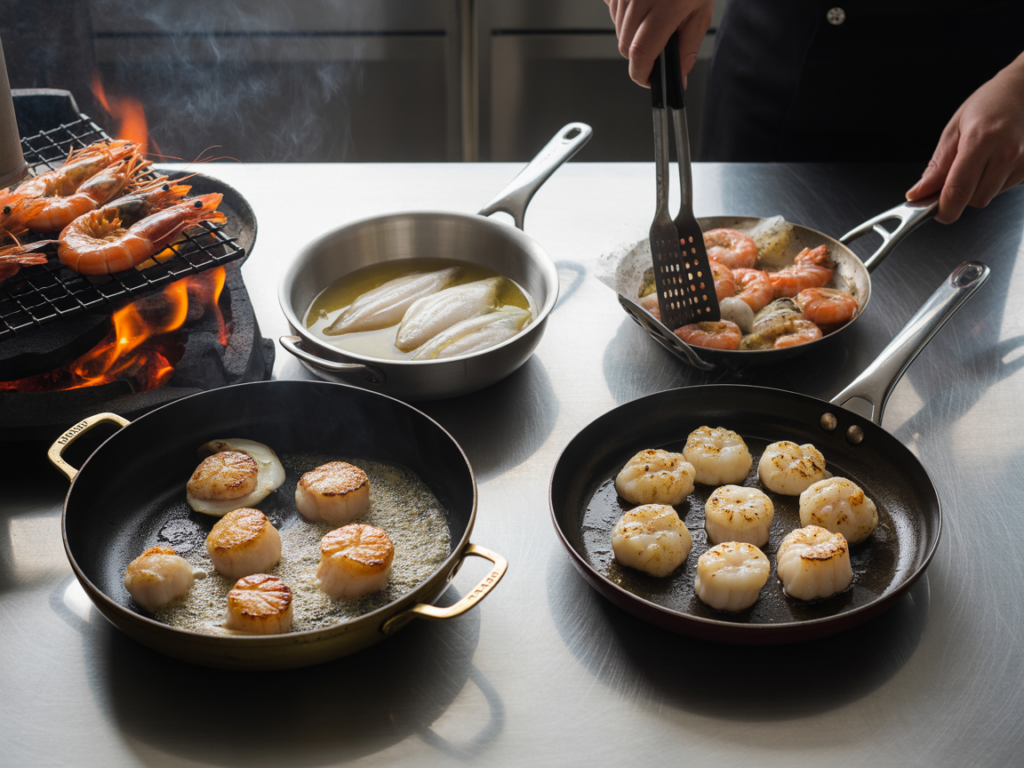
When preparing seafood, cooking technique is not stylistic—it is mechanical science. Each variety of marine protein has distinct structural and biochemical attributes that determine how it responds to heat. Understanding these properties ensures correct outcomes in texture, moisture retention, and flavor concentration. This guide provides a methodical breakdown of which preparations align with the intrinsic characteristics of common seafood selections, using professional culinary logic rather than romantic or narrative framing.
Seafood muscle fibers are shorter and more delicate than land-based proteins. They also contain less connective tissue and different fat distribution patterns. These factors mean that small temperature fluctuations have outsized effects. Overcooking can occur rapidly, and with certain species, irreversible textural degradation can happen within seconds. Thus, matching heat application to structural composition is critical.
For example, crustaceans such as shrimp rapidly contract when heated due to their high protein-coagulation sensitivity. Their ideal preparation requires short, high-precision cooking periods, whether via sautéing or quick blanching, to prevent toughness. Meanwhile, oily fish such as mackerel or salmon retain internal moisture more readily, allowing for more aggressive cooking methods. Lean white fish such as cod or halibut, with low fat and flaky texture, are better suited to gentle heat for structural preservation.
Controlled Heat Applications by Category
1. Lean White Fish (Cod, Haddock, Flounder, Halibut)
These species are low-fat and structurally fragile. Optimal methods: steaming, low-temperature baking, shallow poaching. Target internal temperature: 48–52°C. Goals: prevent fiber separation and maintain translucence.
2. Medium-Fat Fish (Snapper, Sea Bass, Grouper)
Moderate fat content allows for more heat exposure without moisture loss. Optimal methods: moderate-temperature sautéing, controlled grilling. Target internal: 52–56°C. Goals: crisp exterior surface while preserving interior integrity.
3. High-Fat Fish (Salmon, Mackerel, Tuna, Sablefish)
High fat absorbs and distributes heat evenly. Optimal methods: searing, broiling, smoking. Target internal varies by style: 48°C for sashimi-like tenderness, up to 60°C for firm service. Goals: Maillard reaction on exterior while preventing oil expulsion.
4. Shellfish (Mussels, Clams, Scallops, Lobster)
Heat response varies; mollusks open naturally when heated; scallops handle rapid searing; lobster requires staged cooking. Optimal methods: steaming for bivalves; quick pan-searing for scallops; boiling or steaming for lobsters. Target: withdraw from heat immediately upon structural completion.
Pan-Searing Applications
Pan-searing induces the Maillard reaction—browning that results from amino acid and sugar interactions. It should not be used indiscriminately. Only seafood with sufficient surface dryness and moderate to high fat content should be seared. If water remains on the surface, browning efficiency decreases and steaming occurs instead.
Best candidates for searing: salmon, tuna, scallops.
Procedure:
– Light oil film
– Preheated pan at 200°C
– No movement of protein for initial browning phase
– Flip only once
– Resting period post-heat for redistribution of juices
Poaching and Sub-Boiling Methods
Poaching is recommended for delicate textures requiring structural protection. Water should never reach boiling during seafood poaching. Ideal temperature range: 75–85°C. Liquid medium may include salt, aromatic compounds, or neutral broth.
Typical applications: cod loins, halibut, sole.
Benefits: minimal agitation, uniform cooking, moisture preservation.
Grilling Considerations
Direct flame exposure introduces risk if structural fragility is not accounted for. Lean fish require indirect-heat shielding via foil or grill baskets. Strong-fleshed species such as swordfish or yellowfin can withstand direct grill contact.
Key operational parameters:
– Grill grates must be preheated and oiled
– Protein placed at 45-degree angle for contact stability
– Minimal turning (once ideally)
– Monitoring for albumin release as indicator of nearing doneness
Steam Cooking Principles
Steam cooking requires no lipid medium. It is advisable for lean, delicate seafood that lacks inherent oil buffering. Because steam transfers heat efficiently, cooking times are shorter than expected. Observational vigilance is required.
Applications: mussels, clams, thin white fillets.
Procedure:
– Superheated steam environment
– Covered containment
– Immediate removal upon doneness indicators
– Avoid steam-stalling or prolonged after-heat exposure
Quantified Time and Thickness Metrics
A general guideline: seafood typically requires 10 minutes per inch of thickness in moderate heat conditions. However, fat content and structural resilience modify that estimate. High-fat fish may require additional time; lean fish often require less. Crustaceans such as shrimp require time measurement in seconds, not minutes. Their coagulation curve is steep, with structural tightening occurring nearly instantly past threshold.
Identifying Doneness
Correct doneness is a physical condition, not an abstract concept.
Indicators:
– Interior opacity change
– Flake response under light pressure
– Shellfish opening
– Temperature probe readings
– Reduced albumin expulsion
– Elasticity rather than rigidity under utensil pressure
Overcooking symptoms:
– Excessive firmness
– Dryness
– Stringy fiber separation
– Visual whitening beyond structural translucence
These are irreversible outcomes.
Avoiding Common Errors
- Applying excessive heat to lean fish
- Over-handling during cooking
- Using incorrect oil smoke points
- Ignoring carryover heat after removal
- Crowding in pan or steamer causing steam-induced boiling instead of intended method
Recommended Professional Protocol
– Pre-dry surfaces
– Use precision thermometers
– Weigh portions when consistency is required
– Apply heat progressively
– Use timers with sub-minute resolution
– Remove slightly before estimated doneness due to residual heat progression
Summary of Method Alignment
The objective is to match structural characteristics to heat methodology scientifically. Lean fish require gentler applications; high-fat fish tolerate aggressive methods; crustaceans demand rapid execution; mollusks rely on natural structural signaling. Controlled thermal transfer yields predictable, repeatable outcomes. Proper application of these principles results in consistent quality regardless of recipe variability.