Introduction: Nature’s Living Flame
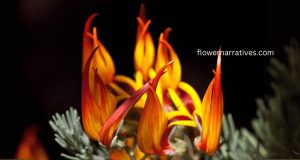
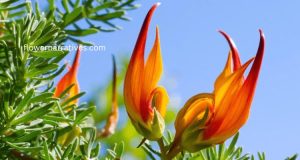
The Parrot’s Beak (Lotus berthelotii) is one of the world’s most spectacular flowers, boasting bright, flaming petals. It is an endemic flower of the Canary Islands, and is unique and dwelt now in history for its red, orange, and yellow color, which seems to be the beak-curved holding of a parrot. Once abundant in the wild, it is now critically endangered, thus constituting one sought-after ornamental plant in botanical gardens all over the world.
It will ultimately enhance its ethereal beauty with cascading vines and delicate silver-green foliage, thus a much-prized addition for hanging gardens and commercial landscape designs. While it seems to be all ornamental, it still remains quite an enigma in nature, and conservationists work extra hard to conserve and propagate this species further into the wild.
Where is the Parrot’s Beak Found?
The Parrot’s Beak was originally present in the Canary Islands–a chain of hot islands found at the western end of the African continent. It could climb to rocky cliffs and slopes, where sun and well-drained soil were guaranteed, but all these years, there have been some relative changes in the surrounding aspects, making it harder and harder to find it in the wild.
🌺 Once found in nature
The Parrot’s Beak was native to Tenerife and La Palma, two of the Canary Islands.
🌺 Difficult to find today
Scientists believe that it may no longer exist in the wild.
🌺 Grown in gardens
Thankfully, people around the world grow the Parrot’s Beak in botanical gardens and home gardens, where it can still bloom beautifully.
🌺 Needs warm weather
This plant thrives in warm places with lots of sunlight, such as Mediterranean gardens and greenhouses.
Although “unnatural” in nature today, many efforts are being developed for its conservation and reintroduction.
What Makes This Plant So Unusual?
Fire-like Petals
The curved shape and fiery color gradient of its petals mimic the beak of a parrot.
Habit
Its vines cascade beautifully for the preparation of hanging baskets or a nice decorative border.
Sun and Drought Resistant
Unlike the majority of exotic flowers, the Parrot’s Beak does splendidly well in hot and dry climates, and so, can be a good addition to Mediterranean gardens.
Rare in Nature’s Bloom
The fiery blooms, which are open when cultivated, are almost more difficult to find, as they need to have cool night temperatures.
Check this post - The Jade Vine, Nature’s Rare Emerald Beauty
Why is the Parrot’s Beak Endangered?
🚨 Loss of Habitat
The area within which a parrot’s beak normally exists has drastically reduced due to urbanization and changes in land use.
🚨 Pollinator Decline
In the wild, it relied on sunbirds to effect pollination, but reproduction became rare because of low bird populations.
🚨 Climate Change
Impossible regeneration of natural habitat so far because of unpredictable weather and elevation of temperatures. This is coupled with limited seed production, posing problems of natural propagation for the Parrot’s Beak, which has low seed viability.
Botanical effort, still, continues to introduce and conserve this excellent flower, but its destiny in the wild is yet to be ascertained.
Symbolism & Meaning of the Parrot’s Beak
🌿 Passion & Vitality
Its vibrant colors symbolize energy, strength, and passion for life.
🌿 Resilience
Despite its endangered status, its ability to thrive in cultivation reflects perseverance and adaptation.
🌿 Exotic Beauty
With its striking appearance, the Parrot’s Beak is a symbol of uniqueness and natural wonder.
FAQs About the Parrot’s Beak
1. Can the Parrot’s Beak be Ground at Home?
Yes! It has made a superb plant for hanging baskets and in rock gardens, but it prefers being in dry, hot climates for magic to really take place. However, it needs cool nights to bloom.
2. Why is it called the Parrot’s Beak?
The curving pointed petals take the form of a parrot’s beak, especially in some brilliant reds and oranges.
3. Is Parrot’s Beak extinct in the wild?
It is classified as critically endangered as there have been no confirmed sightings of it from its natural habitat for decades. However, it still lives through cultivation and conservation efforts.
4. How long does the Parrot’s Beak bloom?
Under very good conditions, it blooms into flame-like flowers during late spring to early summer.
5. Does the Parrot’s Beak attract pollinators?
Yes! In the wild, it relied on sunbirds to effect pollination; in gardens, it would attract bees and butterflies.
Final Thoughts
The Parrot’s Beak embodies beauty, resilience, and perhaps the desired fragility that nature represents. It is no longer alive in the wild, but the conservationists and plant lovers are not letting the fire in its bloom die out in future wonderment.
At Flower Narratives, we travel across the world to find the most unique and rare blooms among flowers and learn their stories, for flowers have a tale to tell.