Introduction
In an era defined by rapid technological advancement, STEM education—Science, Technology, Engineering, and Mathematics—has emerged as a cornerstone of future workforce development. From artificial intelligence and robotics to biotechnology and renewable energy, the fastest-growing industries rely heavily on STEM skills. Equipping students with these competencies is no longer optional; it is essential for preparing them to thrive in the global economy.
1. Understanding STEM Education
STEM education is more than just teaching four subjects—it’s an interdisciplinary approach that fosters:
- Critical Thinking
- Problem-Solving
- Creativity
- Collaboration
Instead of learning in isolation, students engage in real-world projects where scientific principles, technological tools, engineering processes, and mathematical reasoning are applied together.
2. Why STEM Skills Matter for the Future
The jobs of tomorrow will require skills that go beyond routine tasks:
- Automation & AI: Many manual jobs are being replaced by machines, but STEM roles are expanding.
- High-Demand Fields: Careers in data science, renewable energy, software development, and healthcare technology are booming.
- Global Competitiveness: Countries investing in STEM education are better positioned to lead in innovation.
3. Key Benefits of STEM Education
- Promotes Problem-Solving Abilities – Students learn to analyze issues and develop solutions through experimentation and iteration.
- Encourages Innovation – By combining theory with hands-on application, students develop an inventive mindset.
- Prepares for High-Paying Careers – Many STEM-related careers rank among the highest-paying professions.
- Bridges Gender & Opportunity Gaps – Inclusive STEM programs create opportunities for underrepresented groups.
4. Strategies for Implementing Effective STEM Education
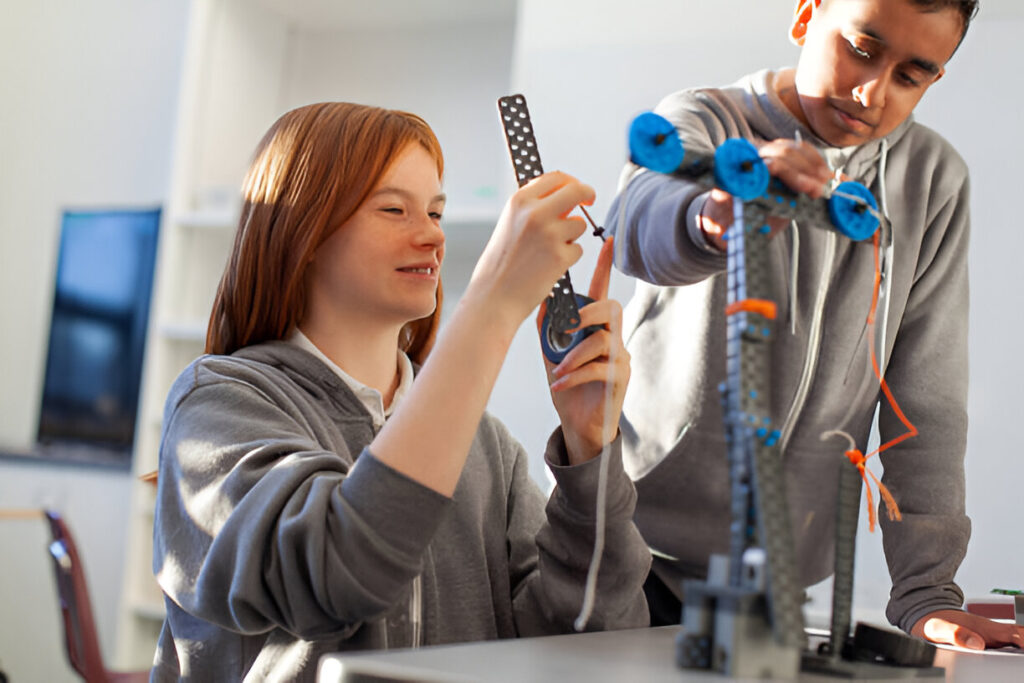
- Project-Based Learning (PBL): Hands-on activities such as building prototypes, coding apps, or designing experiments.
- Integration of Technology: Using AI tools, 3D printers, VR simulations, and coding platforms in classrooms.
- Industry Partnerships: Collaboration between schools, universities, and companies to provide real-world experience.
- Teacher Training: Equipping educators with the skills to teach STEM effectively.
5. Real-World Applications of STEM Learning
STEM knowledge isn’t just academic—it solves real problems:
- Engineering: Designing eco-friendly buildings or transportation systems.
- Technology: Creating software for healthcare diagnostics.
- Mathematics: Using data analytics for climate change research.
- Science: Developing renewable energy solutions.
6. Preparing Students for Jobs That Don’t Exist Yet
A striking fact is that many students today will work in industries that have not yet been created. STEM education provides adaptability:
- Learning how to learn rather than memorizing outdated information.
- Building resilience and curiosity to navigate changing job landscapes.
- Encouraging continuous skill upgrades.
7. The Role of Parents, Educators, and Policy-Makers
- Parents can nurture curiosity with STEM toys, science kits, and museum visits.
- Educators should incorporate inquiry-based learning into everyday lessons.
- Policy-Makers must invest in STEM labs, scholarships, and teacher development programs.
Conclusion
STEM education is more than a curriculum—it’s a pathway to innovation, economic growth, and global leadership. By equipping students with the skills to solve complex problems, think critically, and innovate, we are preparing them not just for the jobs of tomorrow but for shaping the future itself.